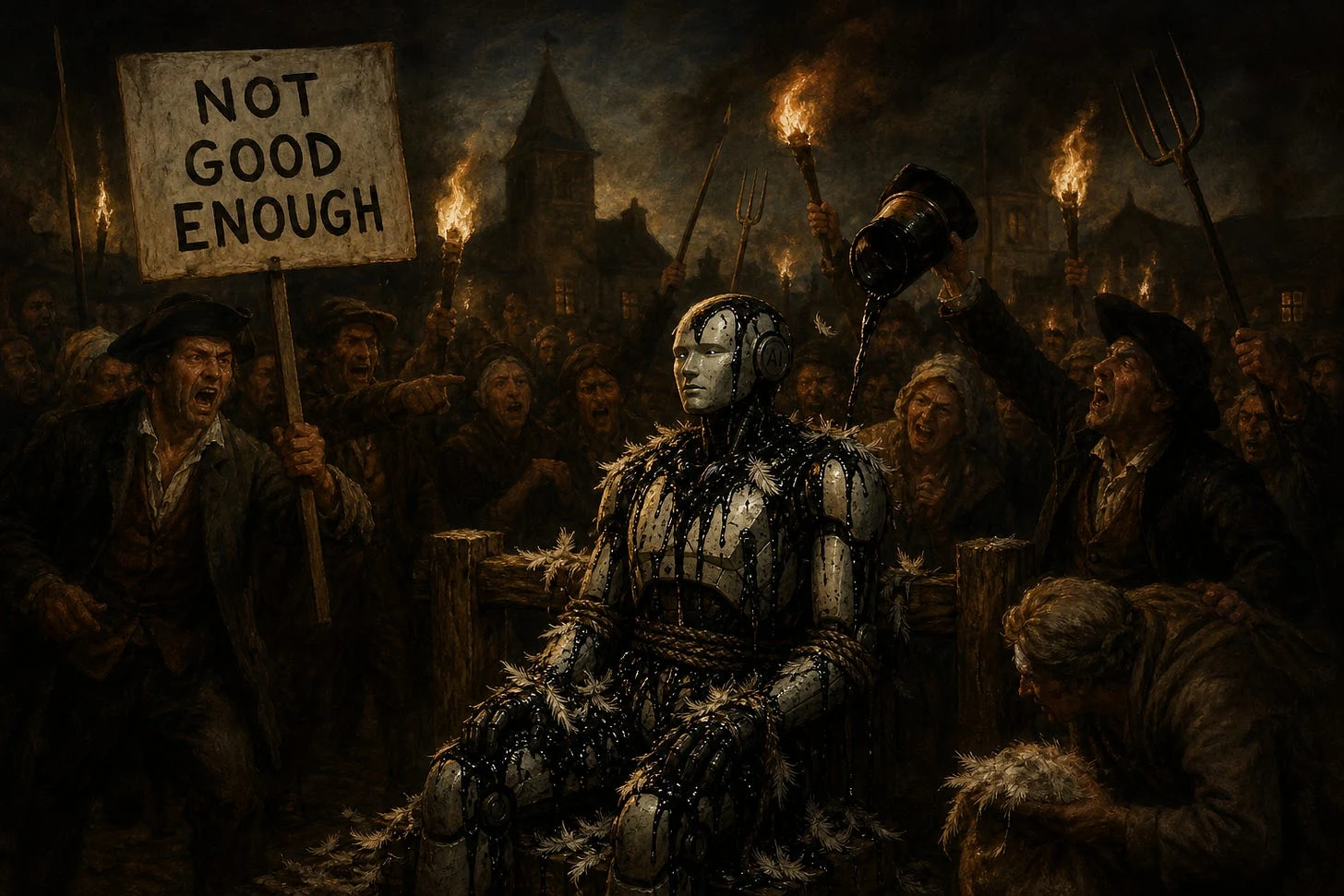
This piece is not an apology for using AI. If you were looking for an apology, move along, there is nothing for you here. Don’t let the block button hit you on the way out.
Here is the AI statement posted on my fiction, in full, because it is the argument and not a disclaimer:
Every story, every character, every choice of what stays and what gets cut is mine. I decide what’s good. I decide what ships. If a scanner reads clean, consistent prose and calls it “AI,” that’s a statement about the scanner’s assumptions, not about who wrote this. Human writing has always been capable of precision. Don’t let a percentage tell you what you already know from reading the thing. If you can’t handle that, block me and move along, you aren’t the kind of reader I want anyway.
On July 21, Substack shipped a button that says the opposite. It says the percentage is the thing you should know. It is measuring the wrong thing, and I am going to spend the rest of this piece telling you exactly which thing.
Authorship Was Never Keystrokes
You are measuring authorship against keystrokes. Authorship was never keystrokes.
The scanner reads the finished text and estimates whether a model touched it. That is the entire question it can ask. It was never built to answer the only question that matters, which is who decided this was good enough to put a name on and send out the door. Those are different specs. One is a fingerprint check. The other is a signature.
I do Risk Management Framework work for a living. In that world there is a role called the Authorizing Official, and the definition is not vague. NIST calls it the “official management decision given by a senior Federal official or officials to authorize operation of an information system and to explicitly accept the risk”. Someone reads the whole package, decides the risk is acceptable, and signs. If it fails, it fails on that name. Every system that ships to production has one, because someone has to be the person who is answerable when it breaks.
Writing has the same seat. I decide what’s good. I decide what ships. No scanner can occupy that chair, because the chair is not made of keystrokes. It is made of accountability, and accountability does not show up in a percentage. It never has.
The Button Substack Shipped
The tool is called “Scan for AI Text.” Substack partnered with Pangram, the detection vendor, and the button estimates how much of a piece was “written by hand or with AI assistance.” It returns a number. Next to the number sits a link that says “Report a detection error.”
Sit with that last part. The tool ships with a built-in admission that it renders verdicts it knows are wrong, and it puts the burden of appeal on the accused. That is the machine version of trial by ordeal.
If the manuscript floats, it’s AI. Burn it. If it sinks... oh well. Either the flag condemns you or the drowning proves your innocence, and either way the work loses. The “Report a detection error” button is the ducking stool with a feedback form bolted to the side.
I have been calling this an AI witch hunt in my notes all week, so I will own the source of the joke. The trial-by-ordeal, weighs-the-same-as-a-duck logic is Monty Python, and I am planting it here as my own treatment of what this tool does. Jessica Waldron reached for the same scene and titled her piece “She Weighs the Same as a Duck.” She got there honestly and so did I. The duck was in the water for both of us.
The name for the harm came from Substack’s own founder. Chris Best coined “Claudefishing” the same day the detector shipped, and he defined it as a reader who unwittingly invests attention “in something with no human thought on the other end,” because “the network is based on trust between people, and that’s why it works.” Grant him both halves. Deception is a real harm. Trust is the real point. Now watch the percentage fail to measure either one.
There is human thought on the other end of my work, more of it than most human-written pieces carry, and there is an accountable name attached to every word. Claudefishing is passing off no-human-thought as human. Signing my own name and building the machine that makes the work consistent is the exact opposite of that. The presence of AI does not prove the absence of a human. Best’s own detector cannot tell a fraud from an author who did more work, because it grades keystrokes, and fraud is not a keystroke problem. Trust is a name on the masthead, not a score on a scanner.
Waldron already said the scanner “can’t see the hard part. It measures the surface of the words and renders a number, and a number feels like a verdict.” Alicia McCalla, writing her own AI statement, calls herself a “Human-Directed Orchestrator” who directs “the thinking, make the decisions, and revise everything until it reflects my voice, my judgment, and my experience.” Both are right. I agree with both.
Here is what neither of them names: the hard part is accountability, and the credential that matters is a job title, not a disclosure percentage. Own your process is the floor. Sign for it is the ceiling.
What Makes Your Slop Better Than Mine
What makes your natively human-produced slop any better than my AI-assisted slop? Not a thing.
Amazon via Kindle Unlimited has been turning out natively human written drivel and slop for decades. Slop is nothing new, and it isn’t unique to AI. It has no sample page and it never did. Slop is an accountability failure wearing whatever tool was handy, and the tool was a keyboard long before it was a model. Nothing about a human hand on the keys makes bad writing good.
The only thing that separates slop from not-slop is the bar, and the seat that enforces it. A percentage does not measure a bar. It measures a keyboard. Nothing else. You can clear a high bar with AI and you can produce landfill without it, and the scanner scores both of them exactly backward, because it is grading the input when the only thing that was ever worth grading is the output and the name on it.
The Machine
This has already been said, by more than just me. Half of Substack said the scanner is wrong this week: Waldron, McCalla, Alex Eos, and the commenters piling into Best’s own post. The stance is a chorus now. What I can do that a chorus cannot is show you the machine that proves it.
I took what every writer attempts, and mostly fails, to hold in their head, and I made it a database.
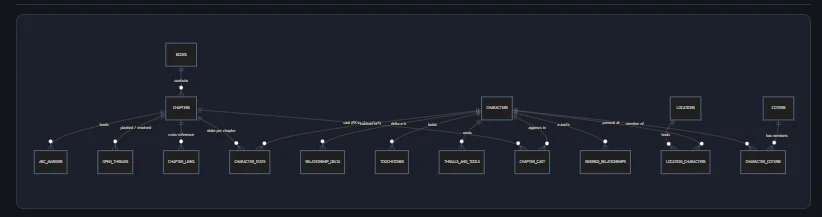
The writing room is a real team, and most of its seats are automatable ones sitting on a read-only data plane. Character and location databases are the researcher and the continuity bible. A synthesis layer that tracks state across chapters is the continuity editor. A standards document with an enforced gate system is the line editor. A dual-scorer that rates every chapter against those standards is quality control.
The one seat that is not automatable is mine, and the architecture guarantees it: the AI cannot write the identity fields, the ages, the canon. It reads. I hold the only write path. That is not a policy I remember to follow. It is a control the database enforces on every call.
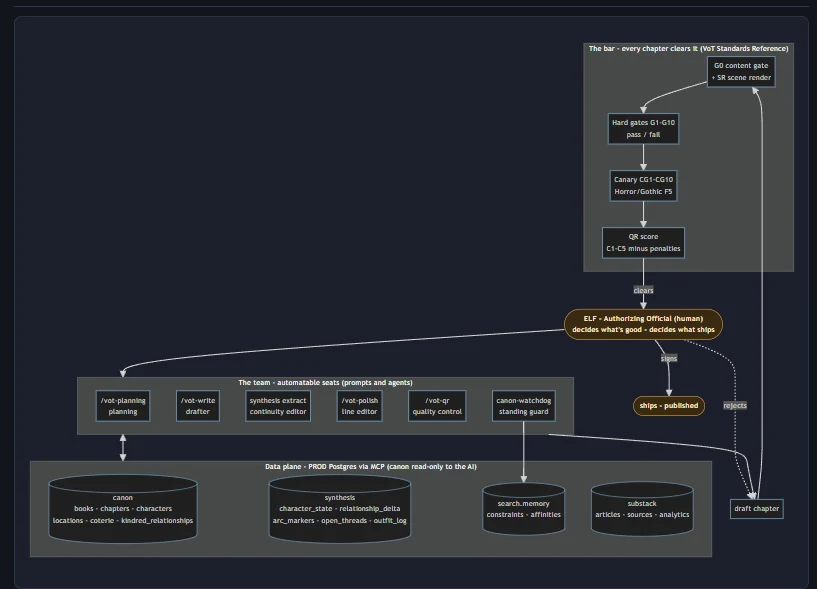
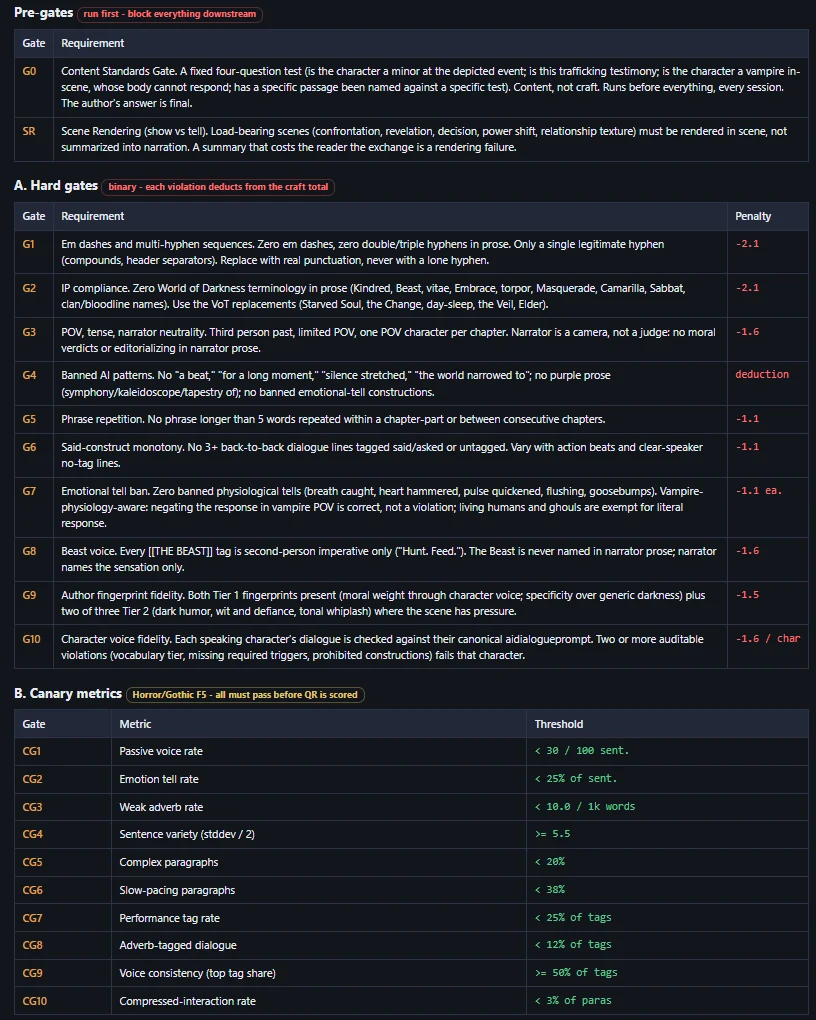
The bar that seat signs against is not this article’s editing checklist. It is the Vampires of Tucson Standards Reference, the criteria I run every scene through: a content gate, a scene-rendering requirement, ten hard craft gates, ten quantitative canary metrics tuned for horror, and a quality score that is only ever measured against the actual file, never projected. Two different systems, and I am not conflating them. The manuscript runs against the Standards Reference. This post ran against a lighter publication checklist. The machine enforces the first one.

AI doesn’t make it easy, it makes it consistent. Easy is the thing people assume and the thing the receipts disprove. Consistency at series scale is the thing a solo human loses first, because context degrades as the work grows. A human holding eleven books in their head will misremember which coat a character wore the night she caught herself working a mark, which lie she told three books ago and has to keep straight now, which night a fifty-year vampire stopped making coffee for men dead since Saigon. The database misremembers none of it. The machine remembers so the sign-off means something.
Here are the receipts. I have put in more work on my writing system than it would have taken to write the novel in the first place. The canon holds 124 character profiles totaling 676,292 characters of text, roughly a novel’s worth of profile before a single chapter is drafted, and 80 of those 124 are deep enough to spawn their own dedicated character agent. The series itself runs 15 books, 318 chapters, 241 of them sketched and 242 drafted, 556,648 words on the board.


That is the counterweight to the lazy-shortcut premise. This isn’t slop. It clears a bar most natively human-written pieces don’t. The whole room is architected as a Risk Management Framework, and I am the Authorizing Official.
Whose Experience It Is
The Authorizing Official owns quality and coherence, and owns the audience experience too. That last one is where the purity-testers lose the thread entirely.
If I cared about your opinion, dear reader, the comments on every single one of my articles wouldn’t be behind a paywall. If you want to argue with me, you get to pay for the privilege, and no, that is not going to change. I decide what the reading experience is, the same way I decide what ships, because it is the same seat.
The people whose opinions I actually care about, have comped subscriptions to my publications for exactly that reason.
If the only thing you have to do with your life is click the “Scan for AI Text” box, then you seriously need to do something better with your existence, because you’re a god-damned waste of flesh. That is aimed with precision. Not at the reader who is unsure how they feel about any of this. At the one who runs a scanner over a stranger’s sentences so they can hold up a number and call it shame. The self-righteous reader who is just inches away from donning a KKK outfit and hunting down authors who use AI to burn them at the stake and/or tar and feather them.
To you I say, “Lan astaslem”, I will not submit, or surrender.
I am not going to pay the machine that tells me I am not good enough. I have switched the detector off on every post I have published (that qualifies), on principle, and I will keep it off. Substack undercutting the writers it lives on is a strange business model, and Alex Eos put the double standard cleanly: when the platform turns your writing into a “pleasant little robot bedtime story, that is innovation,” but when a writer uses the same class of tool to sharpen a transition, the writing becomes suspicious. Eos is right that this “is turning authorship into a police lineup.”
I said in a note this week that Substack was supposed to be different from every other social platform. The witch hunt proved me wrong. Same bullshit, different icon.
The Market Already Does This
Those who do AI badly will not get subscribers. Those who do it well, will. That’s the way the market works. And fuck you for trying to control something the market already does.
Readers sort quality with the one control that has always worked, which is the subscribe button and the unsubscribe button. A writer who does AI badly bleeds subscribers. A writer who does it well keeps them. The detector is an attempt to seize a decision the audience already makes on its own, every day, for free, and to dress that seizure up as protection.
We have run this exact panic before. In February 1982 National Geographic ran a cover of the Pyramids at Giza and nudged them closer together to fit the vertical format, and the reaction told you everything. Digital was not real photography. The darkroom was honest and the computer was fraud.
There were ethics panels and manifestos and a decade of people insisting the tool had killed the craft. Then the work spoke for itself, the good photographers stayed good, the hacks stayed hacks, and now nobody alive argues that a RAW file is a lie. In five years, nobody is going to care, just like the tempest in a teapot over digital photos.
The scanner can tell you a model helped write this. It cannot tell you who is responsible for it. That name is on the masthead, and it does not come off.
Yes, I weigh the same as a duck. Block me or burn me. I don’t care which.
— E.L. Frederick
← Back to Articles