“You don’t get to tell me how to suck eggs. I know it needs doing. I’ll do it my way.”
That was my line, stacked under a note from a writer I am beginning to admire more and more each day. The note was about the block button, and about the people who treat reaching for it as a confession of weakness. She framed blocking and deleting as gardening: you pull the weeds, you do not apologize to the weeds, and the bed is better for it. I read it and felt the specific relief of watching someone name cleanly a thing I already practice.
So here is the named thing, expanded into a position I will defend.
A writer owes you the work, delivered at quality. That is the entire contract. Not the politics, not the agreement, not a debate about whether I qualify, not deference to anyone, and not a chair in the comment section. The work. At quality. Everything past that line is mine to give or withhold, and most of it I am withholding.
That cuts against the received wisdom that a working writer has to build a brand, stay relatable, engage the audience, avoid alienating readers, and earn legitimacy through the institutions of the field. Every one of those is optional. Most are corrosive. And the institutions in question have spent the last few years proving they have no legitimacy left to hand out.
What You Are Owed, and What You Are Not
The platform era sold readers an inversion and never made them sign for it. Somewhere along the way, the audience was taught it is owed the person.
Not the book. The person. The opinions, the availability, the public accounting, the reassurance that the author votes the way you vote and flinches at the things you flinch at. Parasocial culture ran a long con, and the product it sold was the idea that a writer is a public utility you get to file complaints with. It is a con. You were the mark.
You are owed the work. You are owed it at quality, because I do not ship things that fail my own bar, and that bar is not a marketing claim. I will hold a finished book for months rather than release a version that is merely fine. That is the obligation, and I take it seriously enough to eat the delay.
Then there is the part people find rude. If you are not paying me, you are owed nothing beyond the work, which I have mostly given you for free anyway. If you are paying me, you have bought exactly one thing: your opinion gets taken under advisement. “Under advisement” may or may not mean I print it out and shred it. It does not mean editorial control. The only paid perk in this room is the privilege of commenting, and commenting has never been the same as being obeyed.
That is not contempt. It is the actual shape of the deal, said out loud instead of left fuzzy so everyone can imagine a more generous version.
Behold the Field, and It Is Barren
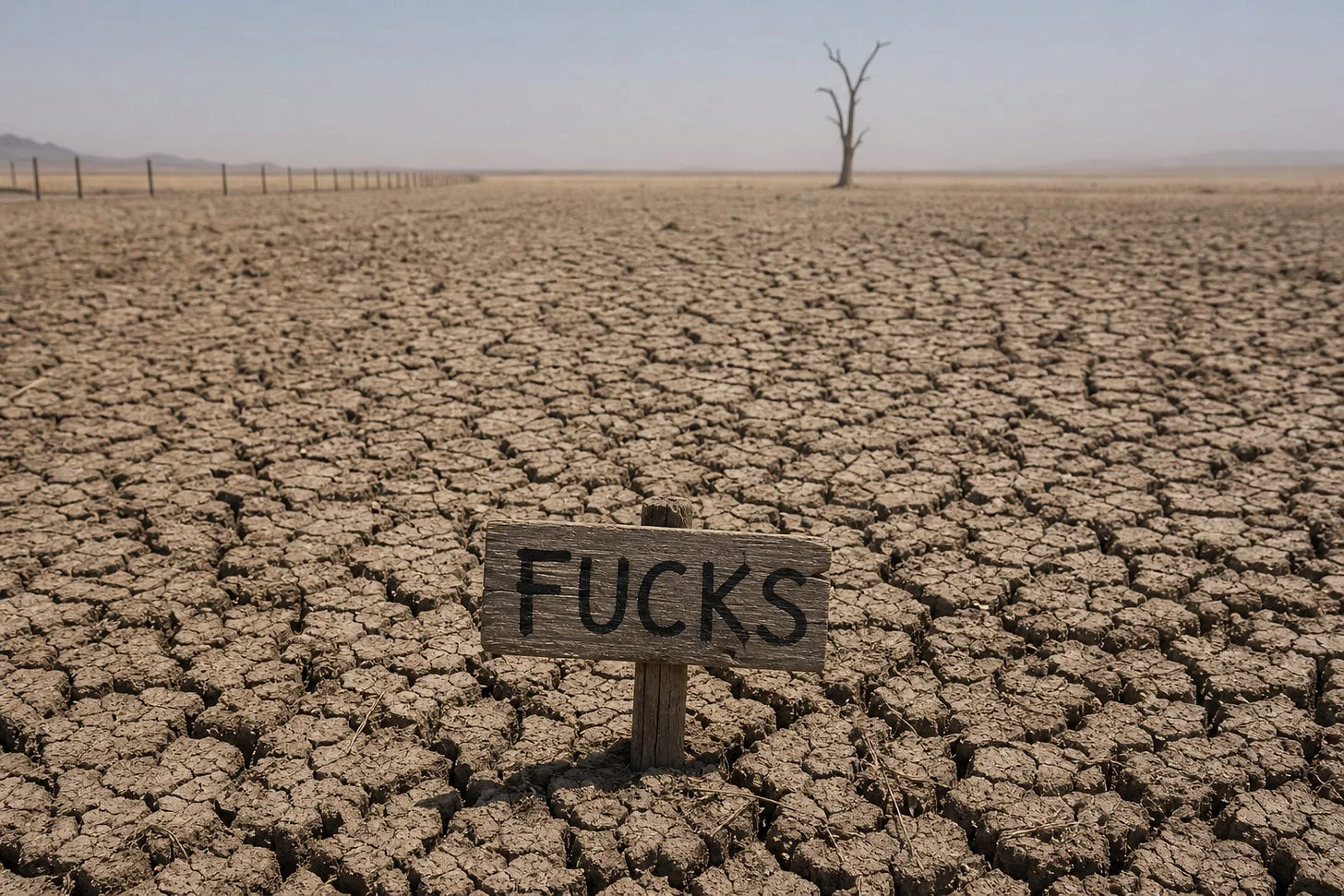
There is a meme about the field in which I grow my fucks. Observe that it is barren. Nothing grows there. Not through neglect. By design.
I do not write politics, on purpose, as standing editorial policy. This publication is about writing, craft, AI, and the work. It is not a place where I tell you how to live, and it is not a place where you get to audit how I do. If you want my position on whatever is lighting up your feed this week, you can keep wanting.
Declining to litigate it here is the position. That is not a claim to have no views. It is a refusal to make my views your business, paired with an equal refusal to make yours mine.
So I do not care how you vote, who you love, what you believe, or which fights you have decided are the measure of a soul this season. Live how you want. I mean that as live-and-let-live, not as a dare. Your life is yours to run or ruin, and the deal runs both directions: I am not grading yours, and you do not get a vote on mine. The field stays barren because I am not growing opinions for you to harvest, and I am not lending you a rake.
The Clipboard at the Gate
The standard rebuttal to all of this is that a real writer earns legitimacy through the field’s institutions. You join, you get recognized, you let the gatekeepers confer the title. So look at what the gatekeepers have been doing with it.
Start with the 2023 Hugo Awards, administered out of the Chengdu Worldcon. The Hugos were among the oldest and most prestigious honors in science fiction. In February 2024, Chris M. Barkley and Jason Sanford published a report built on leaked internal emails showing that finalists had been vetted for political acceptability before they were allowed on the ballot.
Administrator Dave McCarty told his team that if a work focused on “China, taiwan, tibet, or other topics that may be an issue in China,” it had to be flagged so they could decide whether it was safe to allow. Volunteer Diane Lacey later apologized in plain words: “We were told to vet nominees for work focusing on China, Taiwan, Tibet, or other topics that may be an issue in China and, to my shame, I did so.”
Here is the part that kills the easy excuse. The dossiers were not assembled by Chinese officials. They were compiled by American and Canadian administrators, vetting English-language nominees against a foreign government’s sensitivities that no statute had ordered them to enforce. Works with enough votes to make the ballot were ruled ineligible without explanation: R.F. Kuang’s Babel, The Sandman, Xiran Jay Zhao, fan writer Paul Weimer.
McCarty later insisted the calls were his own. Not forced. His. The field’s own people did not let it stand. He was censured, and resignations followed.
Kuang, whose eligible novel was quietly disappeared, gave the verdict the episode earns: “Excluding ‘undesirable’ work is not only embarrassing for all involved parties, but renders the entire process and organization illegitimate. Pity.” Then she added the only sentence that actually matters: “I have books to write.”
That is the cleaner case, because the people running it incriminated themselves in writing. The other one lands closer to home.
In 2022, the Science Fiction and Fantasy Writers Association named Mercedes Lackey a Grand Master, its highest honor, at the Nebula Awards. Less than 24 hours later, it removed her from the rest of the conference. During a panel, while praising the Black science fiction legend Samuel R. Delany, she had used the word “colored.” SFWA’s board stated it was removing her “in accordance with SFWA’s Moderation Policy.”
I am not going to relitigate the word. SFWA called it a Moderation Policy matter, and I will let their framing stand as theirs. What I will not pretend not to notice is the shape of it. An organization crowned its own Grand Master on a Friday and escorted her out of the coronation on a Saturday, over a word spoken in praise of a Black author. The honor and the expulsion came out of the same room, less than a day apart. Whatever you call that, it is not an organization confident that craft is the thing it rewards.
Two institutions. Two independent witnesses to the same disease. One vetted finalists for whether they might upset a host government, and put it in an email. The other threw out the Grand Master it had just crowned, inside a day. Whatever standard those bodies are gating on, it is not craft, and an organization that has shown you that is not one I am going to join, or compromise myself to be let into.
Groucho Marx made a line famous that fits the moment: “I don’t want to belong to any club that would accept me as a member.” The joke was on himself, and I will keep it there. Any club with standards loose enough to take me is already a little suspect. I just extend the same suspicion to the ones whose standards turned out to be this.
And there is no mystery about which side of that clipboard I stand on. I am the kind of writer the gate was built to turn away: the one who put up half a million words in eight months using every tool available, AI included, who runs a documented pipeline and ships nothing that fails my own bar. The writer I admire defends exactly this writer against the people at the gate with a clipboard, the ones asking whether the tools you used mean the work still counts. I am not going to argue that with them. Standing to decline the debate is not the same as dodging it. The books are the argument.
Welcome, or Don’t
None of this means I write into a void or fear a crowd. The work goes out in public and meets everyone on its merits. Argue with it. I argue hard, contested positions in my fiction and on this page, and I am not declining the disagreement. I am declining to host an unpaid debate club in my own living room, which is a different thing entirely.
So the door swings both ways, and I have made my peace with both swings. Like what I write, welcome aboard, genuinely. Don’t like what I write, also fine.
Don’t let the door hit you on the way to the block button. It is right there, and I will use it from my side too. If I don’t ban someone each and every day, I feel like I have wasted the day.
The Harvest Is the Work
Blocking is gardening. You pull the weeds, you do not apologize to the weeds, and the bed grows better for it. Curating who stands in your space is not suppressing discourse, and it is not fragility. It is the maintenance that keeps anything alive. Nobody is owed a place at my table, and the people who read “I blocked you” as “I fear you” have mistaken a garden tool for a white flag.
I don’t fear you. To believe such assumes that I care enough to notice.
So behold the field. It is barren, and it is barren on purpose. I am not growing opinions here for you to pick, not agreement, not access, not a referendum on whether I count as a real writer. The gatekeepers can keep their clipboards.
I don’t write for your approval. I write for mine. A readership is welcome, and I am glad you are here. It was never the point.
The only thing growing in this field is the work. Come back when it is ripe.
— E.L. Frederick
← Back to Articles